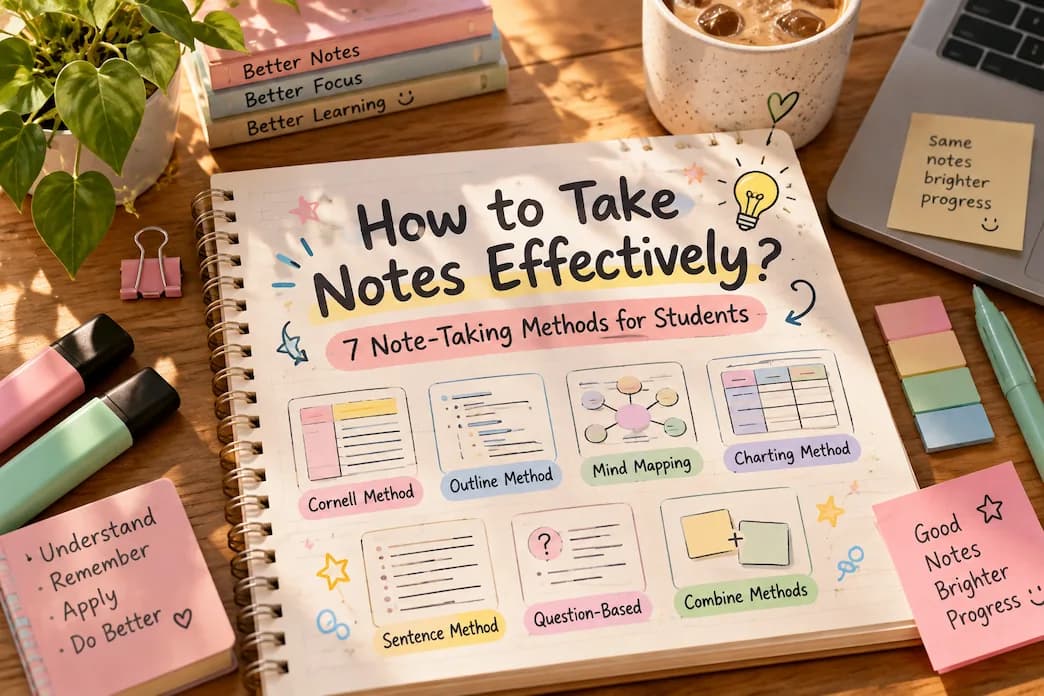
How to Take Notes Effectively: 7 Note-Taking Methods for Students
Learn how to take notes effectively with 7 practical note-taking methods for students, including Cornell notes, mind maps, outlines, and active recall techniques.
Taking more notes does not always mean learning more.
It is easy to fill several pages during a lesson, close the notebook, and realize a few days later that you barely remember what you wrote. The problem is often not effort. It is the way the information was recorded.
Good notes should help you understand a topic, find important information quickly, and make revision easier later. They are not supposed to be a transcript of everything your teacher, textbook, or video says.
So, how do you take notes effectively? The best method depends on the subject, the type of information, and how you plan to review it. These seven note-taking methods can help you build notes that are actually useful when it is time to study.
1. Use the Cornell Method for structured revision
The Cornell Method is one of the most practical note-taking methods for students because it separates information into clear areas instead of filling the entire page with continuous text.
The main section is used for your regular notes. A smaller column is reserved for keywords, questions, or important concepts, while the bottom of the page contains a short summary.
Its biggest advantage appears after the lesson.
Instead of rereading the entire page, you can cover the main notes and use the questions or keywords in the side column to test yourself. This turns the notebook from something you simply read into something you can actively study from.
The Cornell Method works especially well for subjects with explanations, definitions, causes, effects, and connected ideas.
2. Use the Outline Method when the topic has a clear structure
Some subjects naturally follow a hierarchy.
There is a main topic, several subtopics, and smaller details underneath them. In these situations, the outline note-taking method is often more useful than writing full paragraphs.
You begin with the main idea, place related information underneath it, and continue adding smaller points as the topic becomes more detailed.
For example, instead of writing an entire history lesson as continuous text, you might organize it around an event, its causes, major developments, and consequences.
The biggest benefit is visibility. When you return to the page later, you can understand how the information fits together without rereading every sentence.
Just be careful not to turn an outline into another form of transcription. If every line contains a full paragraph, the structure loses its purpose.
3. Try mind mapping for connected ideas
A mind map can be useful when a topic contains many ideas that connect to each other rather than following a simple top-to-bottom order.
Start with the main concept in the center of the page. From there, create branches for major ideas and smaller branches for supporting information.
This format can work particularly well for brainstorming, biology, literature, social sciences, or any topic where relationships between concepts matter.
The goal is not to create the prettiest possible page.
If you spend more time choosing colors, drawing perfect lines, and decorating your notes than thinking about the topic, the method has stopped being useful.
A good mind map should make connections easier to see. It does not need to look like something made for social media.
4. Use the Charting Method when you need to compare information
Some topics are difficult to study because several similar pieces of information need to be remembered at the same time.
This is where the charting method becomes useful.
Instead of writing one section after another, divide the information into categories and compare them side by side.
Imagine studying several historical periods. You could compare their dates, important figures, major events, and results. In science, you might compare different processes according to their purpose, location, inputs, and outputs.
This method reduces the need to search through several pages for information that belongs together.
It is especially effective when the exam requires you to distinguish between concepts that look similar at first.
5. Use the Sentence Method when information moves quickly
Sometimes there is no time to build a perfect structure while taking notes.
During a fast lecture, your priority may simply be capturing the important points before the speaker moves on. The sentence method works well in these situations.
Each new idea is written as a short separate statement rather than being organized immediately into a detailed outline.
The important word here is short.
If you attempt to copy every sentence exactly, you may become so focused on writing that you stop processing the lesson.
Use abbreviations, shorten obvious explanations, and capture the meaning rather than the exact wording whenever possible.
After the lesson, spend a few minutes cleaning up the notes. Add missing headings, mark important concepts, and remove anything that is clearly unnecessary.
That short review can turn rough lecture notes into something much easier to study from later.
6. Turn your notes into questions
One of the most useful ways to improve notes is also one of the simplest: stop writing only answers.
Write questions too.
Instead of recording:
“Photosynthesis occurs in chloroplasts.”
You could write:
“Where does photosynthesis occur?”
Then keep the answer separate or underneath it.
This small change makes your notes much more useful during revision because you can try to answer before looking at the information.
The same approach works for formulas, vocabulary, historical events, definitions, and almost any fact-based subject.
It also connects naturally with active recall. Rather than repeatedly reading information that already looks familiar, you force yourself to retrieve it from memory.
A notebook full of good questions is often more useful before an exam than several pages of highlighted text.
7. Combine methods instead of forcing one system onto every subject
There is no single best note-taking method for every class.
You might use an outline for history, a chart for biology comparisons, a mind map while planning an essay, and question-based notes for vocabulary.
That is completely fine.
In fact, trying to use exactly the same format for every subject can make note-taking less effective.
A useful rule is to ask what you will need to do with the information later.
If you need to compare it, use a chart. If you need to understand relationships, use a mind map. If you need to remember facts, turn them into questions. If you need a clear hierarchy, use an outline.
The method should serve the subject, not the other way around.
Handwritten notes or digital notes: which is better?
Students often ask whether handwritten notes are better than typing.
There is no universal answer.
Handwriting naturally limits how quickly you can record information, which can encourage you to shorten and process what you hear. Digital notes, on the other hand, are easier to search, reorganize, edit, and store.
The real problem begins when typing becomes transcription.
If you can type quickly enough to copy almost every sentence without thinking about it, you may end up with detailed notes that you barely processed.
The better question is not simply paper or laptop?
Ask yourself which format helps you think about the information rather than copy it.
For some subjects, that may be handwriting. For others, especially those involving large amounts of material, digital notes may be more practical.
Common note-taking mistakes that make studying harder
Effective note-taking is often about removing unnecessary work.
The most common problems are writing everything word for word, highlighting almost the entire page, spending too much time decorating notes, and never reviewing them after they are created.
Another common mistake is making notes that only make sense while the lesson is still fresh.
A useful test is to return to your notes several days later. Can you understand the topic without reopening the original textbook or video immediately?
If not, the notes may be missing structure or context.
At the same time, your notes do not need to contain every detail. They should help you reconstruct the important ideas.
How to actually study from your notes
Taking notes is only the first step.
After finishing a topic, close the page and try to explain what you remember. Turn headings into questions. Cover definitions and attempt to recall them. Identify the parts you could not explain without looking.
This is much more valuable than simply reading the same page several times.
You can also separate revision into focused sessions instead of trying to review an entire notebook at once. If you prefer working in clear study blocks, the Odakoo Pomodoro timer can help you dedicate one session to reviewing notes and another to practice questions.
If studying alone makes it difficult to stay consistent, you can also use online study rooms while reviewing your own material alongside other students.
The point is not to spend longer with your notes. It is to make each review require some actual thinking.
How to take better notes
The best notes are rarely the longest ones.
They make important ideas easier to find, show how information is connected, and give you something useful to work with when you return to the topic later.
Start with one note-taking method that fits the subject you are studying. Use it for a few lessons, then ask yourself whether your notes are actually helping during revision.
If they are not, change the method.
Because effective note-taking is not about creating perfect pages.
It is about creating a tool that helps you understand, remember, and use what you learned.