How to Study After School When You’re Tired: A Realistic Routine That Actually Works
Too tired to study after school? Learn how to reset your energy, avoid the after-school scroll trap, and build a study routine you can actually repeat.
You get home at 4:30.
Your backpack hits the floor, you grab something to eat, and you tell yourself you will rest for twenty minutes before studying.
At 6:47, you are still on your phone.
Nothing dramatic happened. You did not decide to waste the evening. You were simply tired, opened one app, watched a few things, replied to a message and slowly lost the transition between school and the rest of your day.
This is one of the most frustrating parts of studying after school: you may genuinely want to study and still feel as if your brain has already clocked out.
The usual advice is to be more disciplined, stop making excuses and “just start.”
That is not particularly useful when you have already spent most of the day listening, reading, solving problems, changing classrooms, talking to people and processing information.
A better question is not, “How do I force myself to study when I’m exhausted?”
It is:
How do I make the transition from school to studying easier enough that I can actually repeat it tomorrow?
Being tired after school does not automatically mean you are lazy
There is a strange expectation that students should be able to move directly from a full school day into another several hours of focused work.
Sometimes you can.
Other days, you get home and even opening your notes feels unusually difficult.
Mental fatigue is real. Long periods of sustained attention can make it harder to concentrate, process new information and continue working at the same level. That does not mean every tired afternoon requires giving up on studying, but it does mean that treating every drop in energy as a discipline problem can lead you in the wrong direction.
The important distinction is figuring out what kind of tired you are.
If you are struggling to keep your eyes open after sleeping five hours, no productivity technique is going to turn severe sleepiness into a great study session.
If you are physically awake but mentally drained from school, a short transition period may be enough.
And if you feel fine until your phone comes out, the problem may not be tiredness at all. It may simply be that a five-minute break turned into forty-five minutes of passive scrolling.
Those situations can feel similar, but they need different solutions.
The biggest after-school mistake often happens before studying begins
Imagine getting home and immediately deciding that you deserve a break.
That is reasonable.
The problem is that “taking a break” has no natural ending.
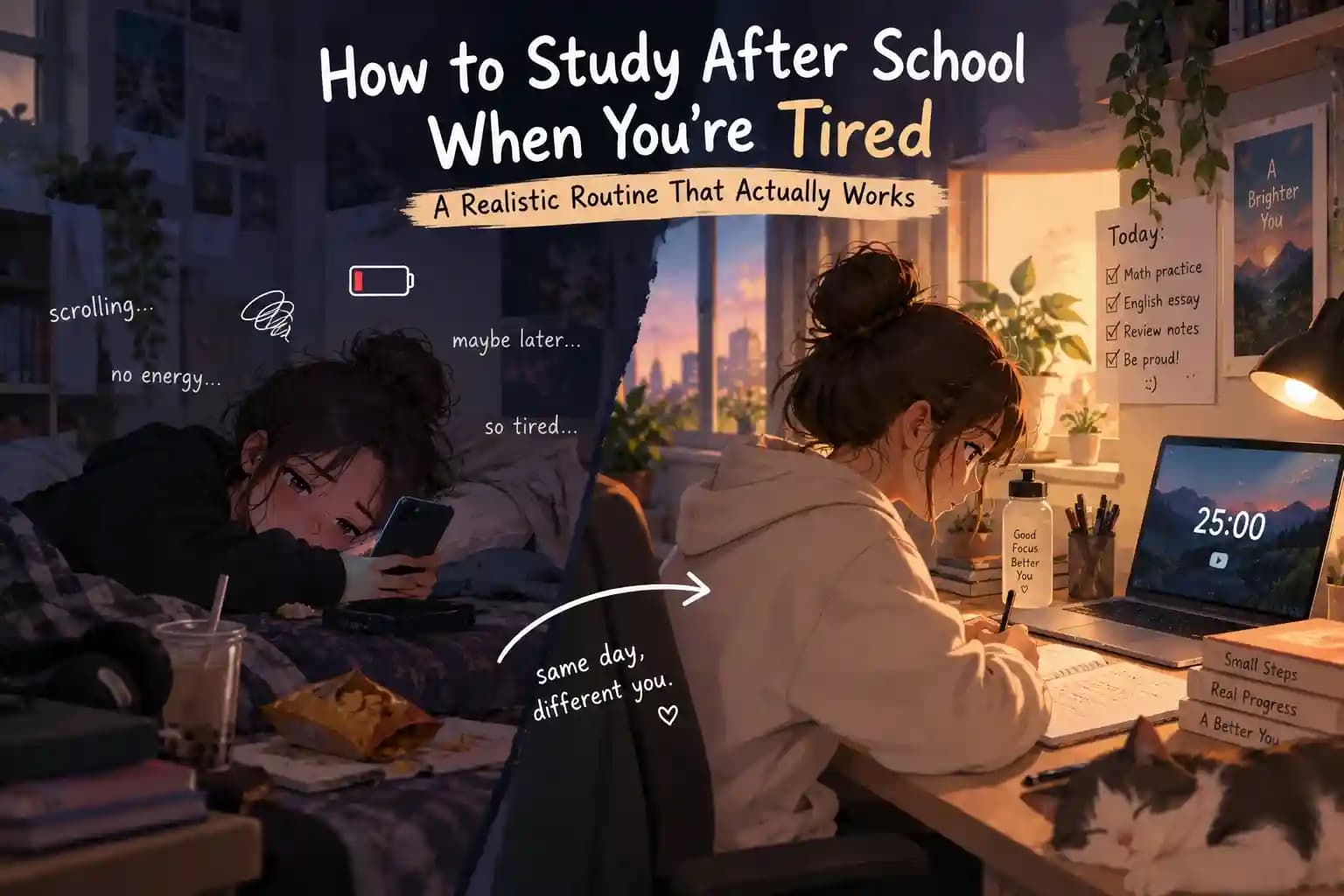
You lie on your bed. TikTok opens. Then YouTube. Then Instagram. You are technically resting, but your attention is still being fed new information every few seconds.
An hour later you do not necessarily feel rested. You just feel later.
This is why the period immediately after school matters so much. You need some distance from the school day, but you also need a point where the break clearly ends.
Try thinking of it as a transition, not an open-ended reward.
Eat something. Change clothes. Take a shower. Walk around for a few minutes. Sit somewhere without your school bag next to you. Do whatever makes you feel like one part of the day has finished.
But give that transition a boundary.
Twenty or thirty intentional minutes can feel very different from collapsing onto your bed with no idea when you are getting back up.
Rest is useful.
Drifting is expensive.
Do not begin the evening by promising yourself three hours
This is where many study plans become unrealistic before the first page is opened.
You come home tired and think:
“I need to study for three hours tonight.”
Your brain does not hear “productive evening.”
It hears a large block of effort standing between you and everything else you would rather be doing.
Instead, make the first commitment much smaller.
Not:
“I’m studying chemistry all evening.”
Try:
“I’m going to finish questions 1–15.”
Or:
“I’ll review yesterday’s vocabulary.”
Or even:
“I’ll do one focused study session and decide what comes next afterward.”
This works especially well when you are tired because you are reducing the number of decisions required to begin. You do not need to feel ready for the entire evening. You only need enough energy for the first task.
If a defined time block helps, opening a Pomodoro timer can make that first commitment feel smaller. Twenty-five minutes is not a rule, and it is not automatically the ideal study duration. It is simply a manageable place to begin when an undefined evening feels too large.
Once you are working, you can decide whether to continue.
Start with the task that creates momentum, not necessarily the hardest one
You may have heard that you should always “eat the frog” and do the hardest thing first.
That advice can be useful when your energy is high.
At 5:30 after a long school day, it can also completely kill the session.
If calculus is the subject you dread most and you are already mentally tired, opening the hardest chapter you have may create so much resistance that you never properly start.
There is nothing wrong with using an easier task to get moving.
Review yesterday’s notes. Do ten straightforward questions. Organize the material you need for tomorrow. Finish a short homework assignment.
The goal is not to spend the entire evening avoiding difficult work. It is to create enough momentum that difficult work no longer feels like the first thing standing between you and the rest of your night.
After fifteen or twenty minutes of real work, switching to the harder task often feels easier than trying to begin with it from zero.
Think of your first task as a runway, not the destination.
Your after-school routine should have a low-energy version
Most study routines are designed for the version of you who is motivated.
That is a problem.
A routine becomes useful when it still works on an ordinary Tuesday when school was annoying, the commute took too long and you would rather do almost anything except study.
So instead of creating one perfect routine, decide what the minimum version looks like.
On a good day, maybe you complete three serious study blocks.
On an average day, you complete two.
On a rough day, perhaps the goal is one focused session, one important assignment and preparing what you need for tomorrow.
That last version is not failure.
It is what prevents one tired afternoon from turning into four days of doing nothing.
Consistency becomes much easier when your routine can shrink without disappearing.
This is also why extremely detailed schedules sometimes fall apart. If your plan says you must study biology from 5:00 to 5:50, mathematics from 6:00 to 7:00 and English from 7:15 to 8:00, being thirty minutes late can make the whole evening feel ruined.
A flexible routine handles real life better.
Know what matters tonight. Decide what comes first. Start.
Be careful with the post-school nap
Sometimes a nap is exactly what you need.
Sometimes it destroys the evening.
If you are genuinely sleepy, especially after a short night, trying to compensate with motivation hacks may be pointless. A brief nap can leave you feeling much more functional.
The danger is the accidental two-hour sleep that begins at 5:00 PM.
You wake up disoriented, your evening is gone, and going to sleep normally later becomes harder.
If naps regularly turn into long sleeps for you, another form of recovery may work better: food, a shower, light movement, some time outside or simply lying down for a short period without actually sleeping.
The goal is not to find the most “productive” type of rest.
It is to find one that gives you some energy back without quietly consuming the rest of your day.
Moving your body can work better than trying to think your way out of fatigue
When you have been sitting through classes for hours, the instinct is often to come home and sit somewhere else.
Sometimes that makes you feel even heavier.
You do not need a full workout before studying. A short walk, stretching, going outside for a few minutes or simply moving around the house can create a clearer break between school and your next focus session.
This is particularly useful when your tiredness feels more like mental fog than actual sleepiness.
Instead of sitting at your desk staring at a textbook while trying to convince yourself to concentrate, leave the desk for ten minutes.
Move first.
Then return.
There is something psychologically useful about coming back to the desk rather than remaining trapped in the same low-energy state and demanding that concentration suddenly appear.
Protect the first ten minutes of your study session
The beginning of a session is fragile.
You have finally sat down. Your notebook is open. Then one notification appears.
You answer it.
Another app is already open, so you check that too.
Five minutes later, the session has technically started but your attention has not.
When you are already tired, switching repeatedly between studying and your phone is especially costly because every return requires another small decision to focus.
So make the opening of the session boring.
Put the phone somewhere you cannot pick it up automatically. Close tabs you do not need. Decide what the first task is before starting the timer.
For the first ten minutes, do nothing except that task.
You do not need to promise yourself that you will become unreachable for the next four hours.
Just protect the beginning.
Once you have moved from “I should study” to actually solving, reading or writing, continuing usually requires less effort than starting did.
If studying alone makes the evening harder, change the environment
Sometimes the problem is not the subject.
It is the feeling of sitting alone at your desk after an entire day of trying to manage your own attention.
Libraries help many students for a reason. You walk in, see other people working and the expected behavior is obvious.
You do not have to generate the entire atmosphere yourself.
You can recreate part of that effect online too.
In a virtual study room, other people can be working on completely different subjects while sharing the same general focus period. Nobody needs to tutor you or constantly talk to you. Sometimes seeing that other students are already in the middle of a session is enough to make your own session feel less isolated.
Odakoo's study rooms are built around that idea: students can join a shared focus space, follow their own tasks and use the room socially when they want to, rather than turning studying into another solo battle with motivation.
The point is not that everyone needs a study group.
It is that environment matters.
If your bedroom constantly turns into scrolling, gaming or sleeping, changing where or how you study may be more effective than endlessly trying to improve your willpower.
What if you are genuinely too tired to study?
Then sometimes the correct answer is to stop.
This is not the most satisfying productivity advice, but it matters.
There is a difference between normal resistance and reaching a point where you are rereading the same paragraph six times without understanding it.
If you have been working all day, are seriously sleep-deprived and cannot process what you are studying, another two hours at the desk may create impressive-looking study time without much learning.
Do the urgent thing if something genuinely cannot wait.
Then sleep.
One bad evening is recoverable.
Turning exhaustion into your normal study strategy is much harder to recover from.
A sustainable routine should help you study regularly without requiring every evening to become a test of how much discomfort you can tolerate.
A realistic after-school routine might be surprisingly simple
You do not need a perfect color-coded schedule.
Imagine you arrive home at 4:30.
You eat, change clothes and decompress until around 5:00.
You take ten minutes to walk, shower or simply reset away from your phone.
At 5:10, you choose one specific task and begin one focus block.
When that session ends, you take a real break and decide whether you have the energy for another.
Maybe you study for two hours.
Maybe today you manage forty-five good minutes.
Over time, what matters more is whether you can repeat the process without spending every afternoon negotiating with yourself for three hours before beginning.
There is a huge difference between a routine that looks impressive on paper and one that survives real school days.
Choose the second one.
Do not wait until you feel completely ready
The strange thing about studying after school is that energy does not always arrive before you start.
Sometimes you feel tired at 5:00, begin anyway, finish a small task and notice that you are more awake twenty minutes later.
Other times you begin and realize you genuinely have nothing left.
Both outcomes are useful information.
That is why the first study block matters so much. It is small enough to test the evening without committing your entire night.
Open your notes.
Choose one concrete task.
If you like working in timed sessions, start a focus block. If you focus better when other people are around, join a study room. If you are exhausted, adjust the plan instead of pretending you are not.
You do not need to “lock in” for five hours every evening to become a consistent student.
You need a way to get from school is over to I have started without losing the entire evening somewhere in between.
Make that transition easier, and studying after school starts requiring a lot less motivation.