Body Doubling for Studying: What It Is and How to Use It
Body doubling is a simple way to make studying feel easier to start: work on your own task while someone else works nearby. Here’s how it works, how to try it online or in person, and how to tell whether it actually helps you focus.
There is a strangely specific kind of procrastination that happens when you know exactly what you need to do.
The textbook is open.
The assignment is due.
You have enough time.
And still, starting feels harder than the work itself.
Then someone sits down next to you and starts working.
You open the document.
You answer the first question.
Twenty minutes later, you realize you have been studying the whole time.
Nothing about the assignment changed. The only difference was that you were no longer doing it completely alone.
That experience has a name: body doubling.
What is body doubling for studying?
Body doubling means doing your own task while another person is present.
They do not have to teach you.
They do not have to check your answers.
They do not even have to be working on the same thing.
You might be revising chemistry while your friend writes an essay. You might solve practice questions while someone beside you answers emails. You may even be in different countries, connected through an online study room.
The important part is simple:
You are both there to work.
A 2024 study involving 220 people found that participants commonly described body doubling as using another person's presence to help them start, stay focused on, or finish a task. That other person could be nearby or remote, someone they knew or a stranger, and even live or recorded.
So body doubling does not have to mean sitting across from a friend in a library.
It can look like:
studying beside a classmate
joining a silent video call
working in a library
using a virtual study room
watching a Study With Me livestream
studying while a friend quietly works on something else
That flexibility is one reason the idea has spread well beyond traditional study groups.
Body doubling is not the same as group study
This difference matters.
In a normal group study session, everyone may be working on the same subject.
You discuss questions.
Someone explains a difficult topic.
You compare notes.
You quiz each other.
Body doubling can be much quieter.
Your study partner does not need to interact with your work at all.
Imagine two students sitting at the same table.
One is studying biology.
The other is preparing a presentation.
For 50 minutes, neither speaks.
They are technically studying together, but they are not collaborating.
That is much closer to body doubling.
This makes it useful when the problem is not:
“I don't understand this.”
but rather:
“I cannot get myself to start this.”
Why can studying beside someone feel easier?
There is no single proven explanation that accounts for every person, and body doubling should not be treated as a guaranteed productivity method.
Still, several parts of the experience are easy to recognize.
The session has a clear beginning
When you study alone, starting can stay vague for a surprisingly long time.
“I'll start after dinner.”
Then:
“I'll start at 7.”
At 7:08, 7:30 suddenly feels cleaner.
Then you check one thing on your phone.
A body-doubling session creates a clearer moment.
Your friend arrives.
You join the room.
The timer starts.
Now the decision has already been made.
You are studying.
Someone else's focus changes the atmosphere
Think about the difference between your bedroom and a quiet library.
Your biology notes are identical in both places.
But the environment is not.
In a library, people around you are reading, typing and taking notes. There is a shared understanding of what the space is for.
A body double can create a smaller version of that effect.
When you look up and see someone else still working, it becomes a gentle reminder of what you intended to do.
They do not need to tell you to focus.
Their presence is enough.
Your goal becomes more concrete
Body doubling also works well with a quick check-in.
Not:
“I'm studying tonight.”
But:
“I'm doing questions 1–25 from this chapter.”
Once you say that out loud or write it in a room, the task stops being an undefined plan.
You know what the session is for.
That clarity is useful even if the other person never asks whether you finished.
Does body doubling actually work?
For some people, it appears to be genuinely useful.
But it is important not to exaggerate what the research currently tells us.
The 2024 ACM study on body doubling was designed to understand how people use the practice and why they say they use it, rather than prove that body doubling improves grades, attention or productivity for everyone.
CHADD, an ADHD advocacy organization, similarly notes that there has not been enough research to fully establish how or why the technique works, even though many people report finding it helpful.
More recently, researchers studying Study-With-Me videos examined them as a form of digital body doubling. In an experiment with 410 participants, livestreams and visible signs of other viewers increased the sense of social presence. Greater social presence was associated with learning persistence, concentration and reduced feelings of loneliness. The researchers also found a trade-off: additional social cues could introduce distractions.
That last part is worth remembering.
More people does not automatically mean more focus.
The useful part is the presence.
Not the noise.
You do not need ADHD to try body doubling
The term is strongly associated with ADHD communities, and body doubling has long been discussed as a strategy some people with ADHD use to manage tasks and focus. Cleveland Clinic and CHADD both describe it in that context.
But the basic activity itself is not exclusive to people with ADHD.
You have probably experienced some version of it without ever using the term.
Maybe you studied better when your sibling was doing homework at the same table.
Maybe you went to a café because working at home felt impossible.
Maybe you called a friend before an exam and both stayed on the call without speaking.
Those are all very similar situations.
You do not need a diagnosis or a special system to test whether working around another person makes starting easier for you.
And if it does not help, there is no reason to force it.
Some people genuinely focus better alone.
How to try body doubling for studying
Do not begin by building a complicated routine.
Try one session.
1. Choose one specific task
Avoid:
Study physics.
Use:
Finish 20 questions on Newton's laws.
Avoid:
Work on my essay.
Use:
Draft the introduction and first paragraph.
Your body double does not need to know the details.
You do.
2. Decide how long you are working
A first session does not need to last three hours.
You could try:
25 minutes of focus + 5 minutes of break
or:
50 minutes of focus + 10 minutes of break
The exact duration is not the important part.
Choose a block that feels realistic enough that you will actually start it.
3. Say what you are going to do
Keep the check-in short.
“I'm finishing 20 math questions.”
Your partner might say:
“I'm reading two chapters.”
Done.
You do not need a motivational speech.
4. Work independently
Now leave each other alone.
This is the part people sometimes accidentally ruin.
You do not need to keep asking:
“How's it going?”
“Which question are you on?”
“Are you nearly done?”
If constant conversation begins, you have turned the focus session into a social session.
Save the conversation for the break.
5. Check in when the session ends
A useful check-in can be one sentence.
“Finished 17 out of 20.”
or:
“The introduction took longer than expected, so I'll continue from paragraph two next time.”
That gives the session an ending without turning it into a performance review.
Who can be your body double?
Almost anyone who can respect the working arrangement.
A friend
This is usually the easiest option.
The risk is obvious: you may spend the entire session talking.
Agree beforehand that conversation happens during breaks.
A classmate
This works especially well when your schedules already overlap.
You can sit together after class without necessarily studying the same subject.
A family member
They do not even need to be studying.
You might revise at the kitchen table while someone else works on their laptop.
The shared working atmosphere can be enough.
Someone in a library or café
This is the least formal version.
Nobody has agreed to be your body double.
You are simply placing yourself in an environment where other people are already working.
For some students, that is all they need.
An online study partner
If your friends do not study at the same times as you, virtual body doubling removes the location problem.
You can both open a call, state your goals, mute yourselves and work.
You do not need to share your screen.
You do not need to use your camera unless both of you want to.
People in a virtual study room
You do not even need a permanent study buddy.
A live study room can provide the same basic sense of shared presence while everyone works independently.
This is useful when you want the structure of studying around other people without arranging a session with one particular friend every day.
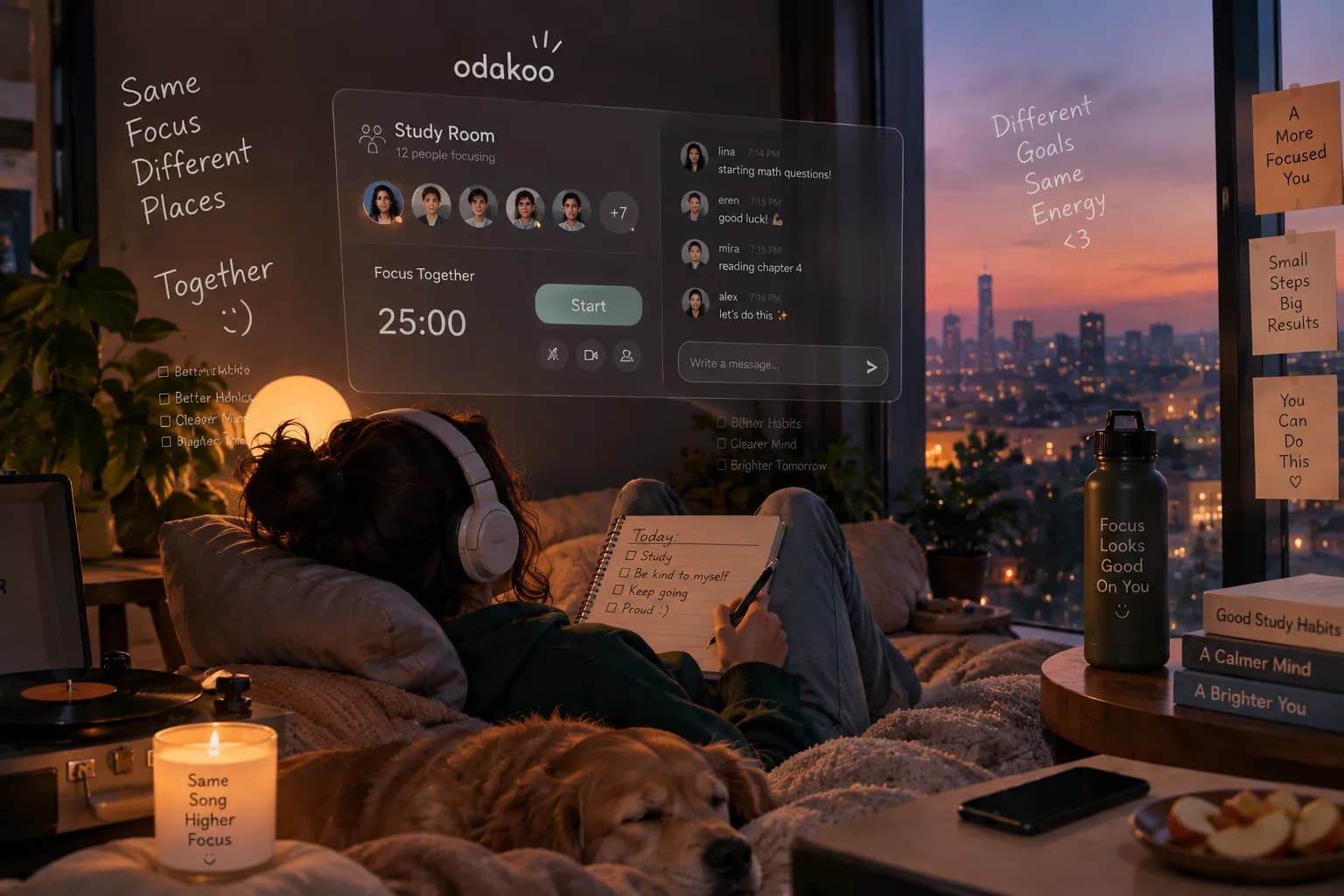
What is virtual body doubling?
Virtual body doubling is simply body doubling when the other person is not physically beside you.
A common setup looks like this:
You join an online room.
Other people are already studying.
You choose your task.
A timer begins.
Everyone works on their own thing.
During the break, some people talk.
Then the next focus period starts.
The actual studying is still individual.
The room simply gives it a social setting.
This is also why Study With Me videos can feel different from ordinary background videos. Someone else is visibly doing the same kind of thing you are trying to do.
Recent research has explicitly described Study-With-Me videos as a form of digital body doubling.
A live virtual room adds one more element: the other people are working right now, not in a recording made months ago.
Body doubling vs. Study With Me
They overlap, but they are not exactly the same thing.
Body doubling describes the broader idea of doing your task in the presence of someone else.
Study With Me usually describes content or sessions specifically built around studying alongside another person.
So:
Watching a student revise on a livestream can be body doubling.
Studying silently on a call with your friend can be body doubling.
Sitting next to someone in a library can be body doubling.
Joining a live online study room can be body doubling.
The format changes.
The shared presence stays.
Body doubling vs. Pomodoro
These two are also easy to confuse because they are often used together.
Pomodoro manages time.
Body doubling changes the environment around the task.
You can use body doubling without a timer.
You can use Pomodoro completely alone.
Or you can combine them.
For example:
19:00 — state your goals
19:05 — 25-minute focus session
19:30 — 5-minute break
19:35 — second focus session
This is one reason virtual study rooms and Pomodoro timers pair naturally.
The room gives you people to focus alongside.
The timer gives the session boundaries.
How to body double online without making it distracting
This is where a good idea can go wrong.
If you spend the entire session watching everyone else, reading messages or thinking about whether your camera looks good, the body double has become another distraction.
Keep the setup boring.
That is a compliment.
Mute notifications
You do not need a sound every time someone enters the room or sends a message.
Keep chat for breaks
If possible, treat focus time as quiet time.
Do not obsess over cameras
Some people like seeing another person working.
Others become self-conscious.
Use whichever setup makes you think less about the room and more about the task.
Avoid constant progress checks
You are not competing.
Your partner does not need to know whether you completed question 14 three minutes faster than they finished their paragraph.
Keep your own task visible
Your textbook, document or problem set should remain the main thing on your screen.
The study room is the background.
Not the activity.
What if your body double distracts you?
Then they may simply be the wrong body double.
Some people make excellent friends and terrible study partners.
If every five-minute break becomes 25 minutes, change the rules.
If that does not work, change the person.
You can also reduce the amount of interaction.
Instead of a video call, use:
audio only
a silent online room
a shared timer
a library
a Study With Me video
Body doubling exists on a spectrum.
You are allowed to choose the least social version that still helps.
What if your study partner does not show up?
Study anyway.
This is an important rule.
A body double should support your routine, not become a requirement for it.
If you planned to begin at 7 PM and your friend cancels at 6:55, you still begin at 7.
Use a solo timer.
Go to the library.
Join a public virtual study room.
The habit you are trying to build is starting your work, not waiting until another person makes starting possible.
Can strangers be body doubles?
Yes.
The research on how people use body doubling includes strangers as well as people they already know.
That is effectively what happens in a library.
You do not know the person at the next table.
Their work still contributes to the atmosphere.
Online, however, normal privacy rules still matter.
You do not need to give someone your phone number, school, home address or personal social accounts just because you study together.
Use the platform's privacy tools and leave any room or conversation that makes you uncomfortable.
For younger students, this is especially important.
When is body doubling most useful?
You may find it worth testing when:
you keep delaying the start of a task
studying alone feels unusually dull
you repeatedly reach for your phone
you have a long independent assignment
you want a regular study appointment
you work better in libraries than in an empty room
you want accountability without active supervision
There are also situations where it may not help.
If the task already requires deep concentration and other people's presence keeps pulling your attention away, studying alone may be better.
If you are constantly monitoring what everybody else is doing, reduce the social elements.
The point is not to use body doubling because the technique has a name.
The point is to find an environment where doing the work becomes easier.
A simple body-doubling session you can try tonight
Keep the first attempt almost boringly simple.
Before the session — 2 minutes
Choose one task.
Put your phone out of reach.
Open the material you need.
Tell the other person your goal.
Focus — 25 minutes
Work.
No conversation.
No checking each other's progress.
Break — 5 minutes
Stand up.
Get some water.
Talk briefly if you want.
Focus — 25 minutes
Continue.
End — 2 minutes
Say what you completed.
Decide where you will start next time.
That is a complete body-doubling session.
You do not need an elaborate productivity system around it.
Trying body doubling in an online study room
If you do not already have someone to study with, a virtual room is an easy way to test the idea.
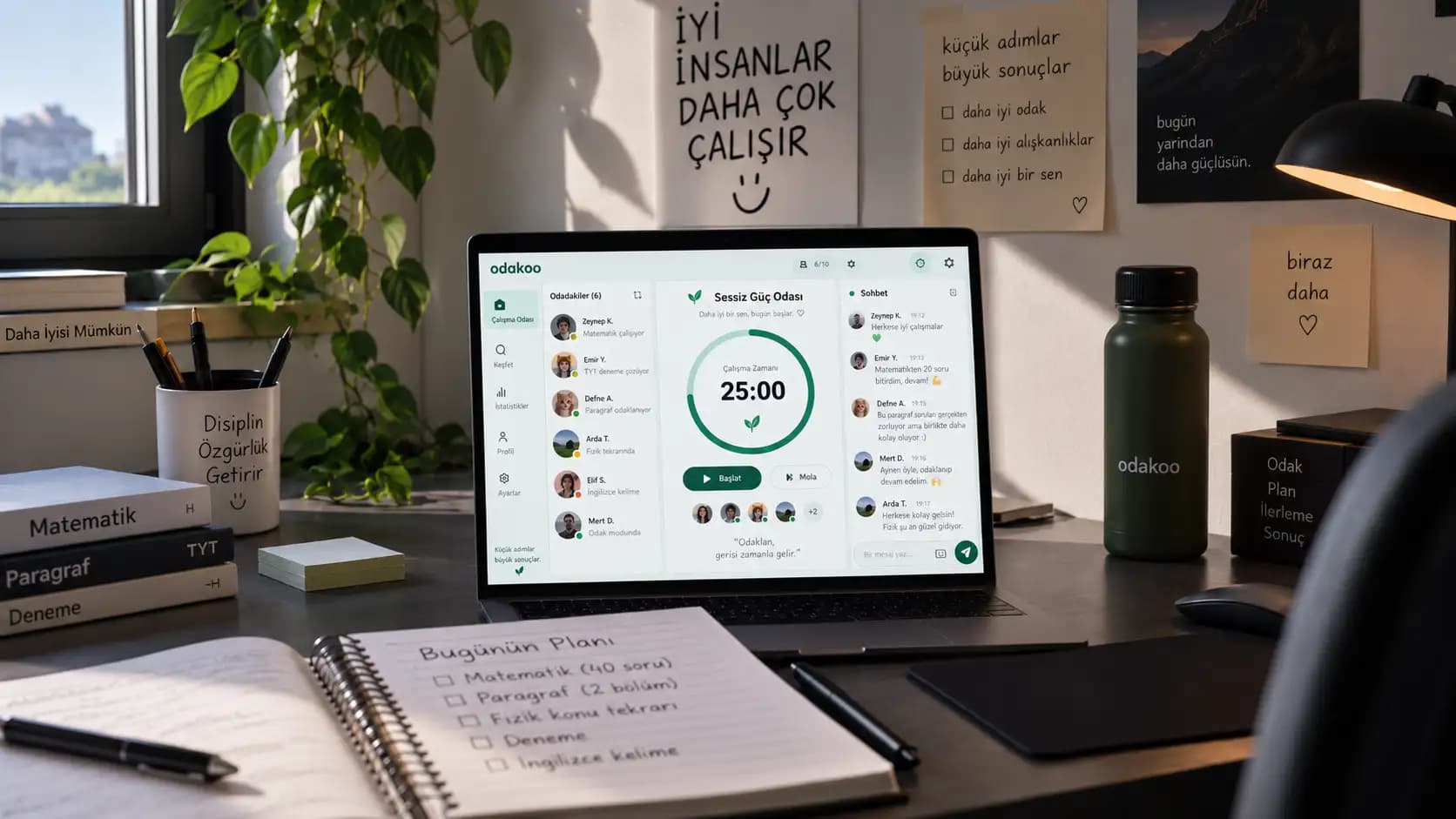
Odakoo's live study rooms are built around the same basic rhythm: people join the same space, work on their own tasks and use focus periods to study together without needing to work on the same subject.
You might be solving calculus.
Someone else might be reading a novel.
Another person might be preparing for an exam.
That does not matter.
For the next focus block, everyone has somewhere they intend to be.
At their desk.
Working.
If you want to try it, join a live study room, choose one task and give yourself a single focus session before deciding whether the method suits you.
Frequently Asked Questions
What does body doubling mean in studying?
Body doubling for studying means working on your own study task while another person is present. They can be beside you physically or connected online, and they do not need to study the same subject.
Does your body double have to work too?
Not necessarily, although many people prefer it when both people are working. The important part is that the other person's presence supports rather than interrupts your task.
Can body doubling be done online?
Yes. Virtual body doubling can happen through video calls, online study rooms, livestreams or other shared online focus spaces.
Is a study buddy the same as a body double?
Not always. A study buddy may discuss lessons, solve questions with you or review material together. A body double can simply work quietly beside you without participating in your task.
Do I need my camera on for virtual body doubling?
No. Some people find a camera helpful because the other person's presence feels stronger, while others find it distracting. Use the lowest level of interaction that helps you work.
Is body doubling only for people with ADHD?
No. The term is widely discussed in ADHD communities, but anyone can try studying alongside another person. Research specifically proving its effectiveness across different groups is still limited.
Does body doubling improve grades?
There is not enough evidence to claim that body doubling directly improves grades. It is better understood as a way some people use shared presence, structure and accountability while doing tasks.
Can I combine body doubling with Pomodoro?
Yes. One person provides the shared presence; Pomodoro provides the time structure. For example, two people can work silently for 25 minutes and talk during a five-minute break.
One session is enough to test it
You do not have to decide whether body doubling is your new study method.
Try it once.
Choose the chapter you have been avoiding.
Sit beside someone who is already working, call a friend, open a Study With Me session or join a quiet online study room.
State what you are going to finish.
Then stop thinking about the productivity method.
Do the work.
If having another person there made starting easier, you learned something useful about how you study.
If it did not, you learned that too.
Either result is better than spending another hour searching for the perfect way to begin.