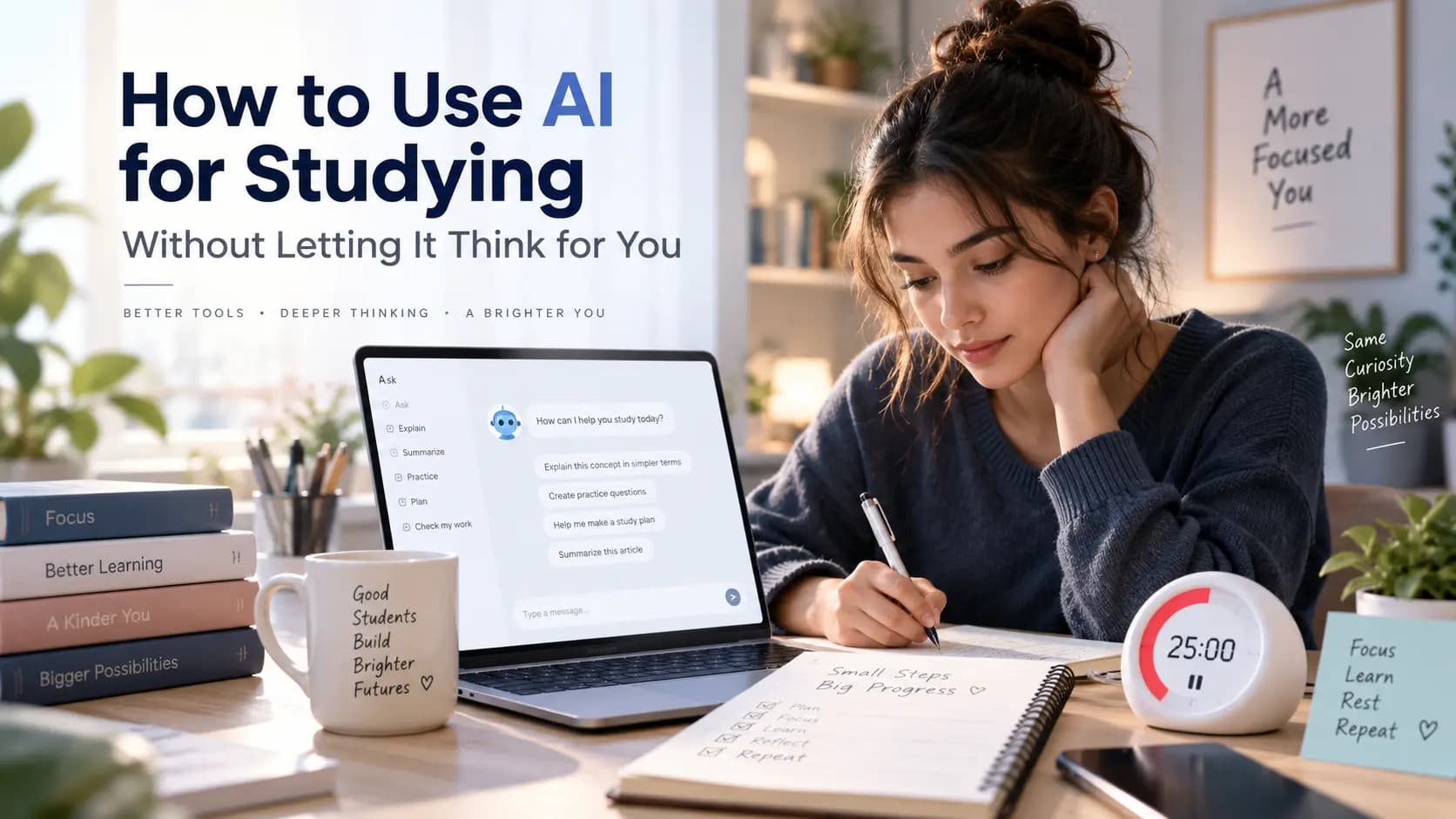
How to Use AI for Studying Without Letting It Think for You
How to Use AI for Studying Without Letting It Think for You
AI can explain almost anything in seconds.
That sounds perfect for students. Stuck on a math problem? Ask AI. Don’t understand a chapter? Ask AI. Need notes, flashcards, examples, or a summary? AI can create all of them before you even finish opening your textbook.
But there is a problem.
If AI does too much of the difficult thinking for you, studying can start to feel productive without actually being productive.
You finish faster. Your notes look cleaner. Everything seems easier.
Then the exam arrives and suddenly there is no chatbot sitting next to you.
The better way to use AI for studying in 2026 is not to avoid it. It is to learn where AI should help you — and where your brain still needs to struggle a little.
AI Should Be Your Study Partner, Not Your Replacement
Think about AI like a very patient tutor.
A good tutor does not immediately give you every answer. They help you understand the problem, ask questions, and point you in the right direction.
Your AI study workflow should work the same way.
Instead of:
“Solve this problem for me.”
Try:
“Give me one hint without revealing the answer.”
Instead of:
“Summarize this entire chapter.”
Try:
“Ask me five questions to check whether I understood this chapter.”
That small difference matters.
In the first version, AI is doing the mental work. In the second, AI is creating an environment where you still have to think.
The Biggest AI Study Trap: Mistaking Recognition for Learning
One of the easiest mistakes to make while studying is confusing “this looks familiar” with “I actually know this.”
AI can make this problem even worse.
You ask for a summary, read it once, and everything makes sense. You recognize the concepts. The explanation feels clear.
So your brain tells you:
“Yeah, I know this.”
But close the page and try to explain the same topic without looking.
Suddenly, it becomes much harder.
That is because recognition and recall are not the same thing.
Real learning usually happens when your brain has to retrieve information, connect ideas, make mistakes, and try again.
This is why active recall, practice questions, self-explanation, and spaced repetition are still powerful — even in the age of AI.
How to Use AI for Studying the Right Way
Here are a few ways to use AI without turning your study session into passive reading.
Ask AI to Quiz You
Instead of asking for more notes, ask AI to test what you already know.
For example:
“Create 10 questions about photosynthesis. Start easy and gradually make them harder. Don’t show the answers until I reply.”
This turns AI into an interactive study partner.
You can also ask it to explain why your answer was wrong instead of immediately giving you the correct one.
Ask for Hints, Not Solutions
If you are solving math, physics, coding, or logic problems, avoid asking for the complete solution immediately.
Try:
“I’m stuck on step three. Give me a small hint.”
This keeps you involved in the problem.
The goal is not to finish the question as quickly as possible. The goal is to train yourself to solve similar questions later without help.
Explain the Topic to AI
One of the simplest ways to test your understanding is to explain a topic in your own words.
You can tell AI:
“I’m going to explain this topic to you. Tell me which parts are incorrect or incomplete.”
Then write everything you remember.
This is similar to the Feynman Technique: if you cannot explain something simply, you probably do not understand it as well as you think.
Use AI to Generate Practice Questions
Practice questions are one of the best uses of AI for studying.
You can paste your notes or describe the topic and ask for:
Multiple-choice questions
Open-ended questions
Flashcards
Mini quizzes
Exam-style questions
True or false questions
The important part is to answer them before seeing the solutions.
Use AI After You Study, Not Before
This is a simple rule that can change how you use AI.
Try learning the topic yourself first.
Read the chapter. Watch the lesson. Take notes. Solve a few questions.
Then use AI to find the gaps in your understanding.
This prevents AI from becoming the first place your brain goes whenever something feels difficult.
And difficulty is not always bad.
Sometimes that uncomfortable moment of trying to remember something is exactly where learning happens.
A Better AI Study Session
Here is a simple example of what a balanced study session could look like.
First 25 minutes:
Study normally. Read, take notes, or solve questions without AI.
Then take a short break.
Next 25 minutes:
Use AI to quiz yourself on what you studied.
Ask it to identify weak areas but not immediately explain everything.
Then take another short break.
Final session:
Return to the topics you struggled with and try again.
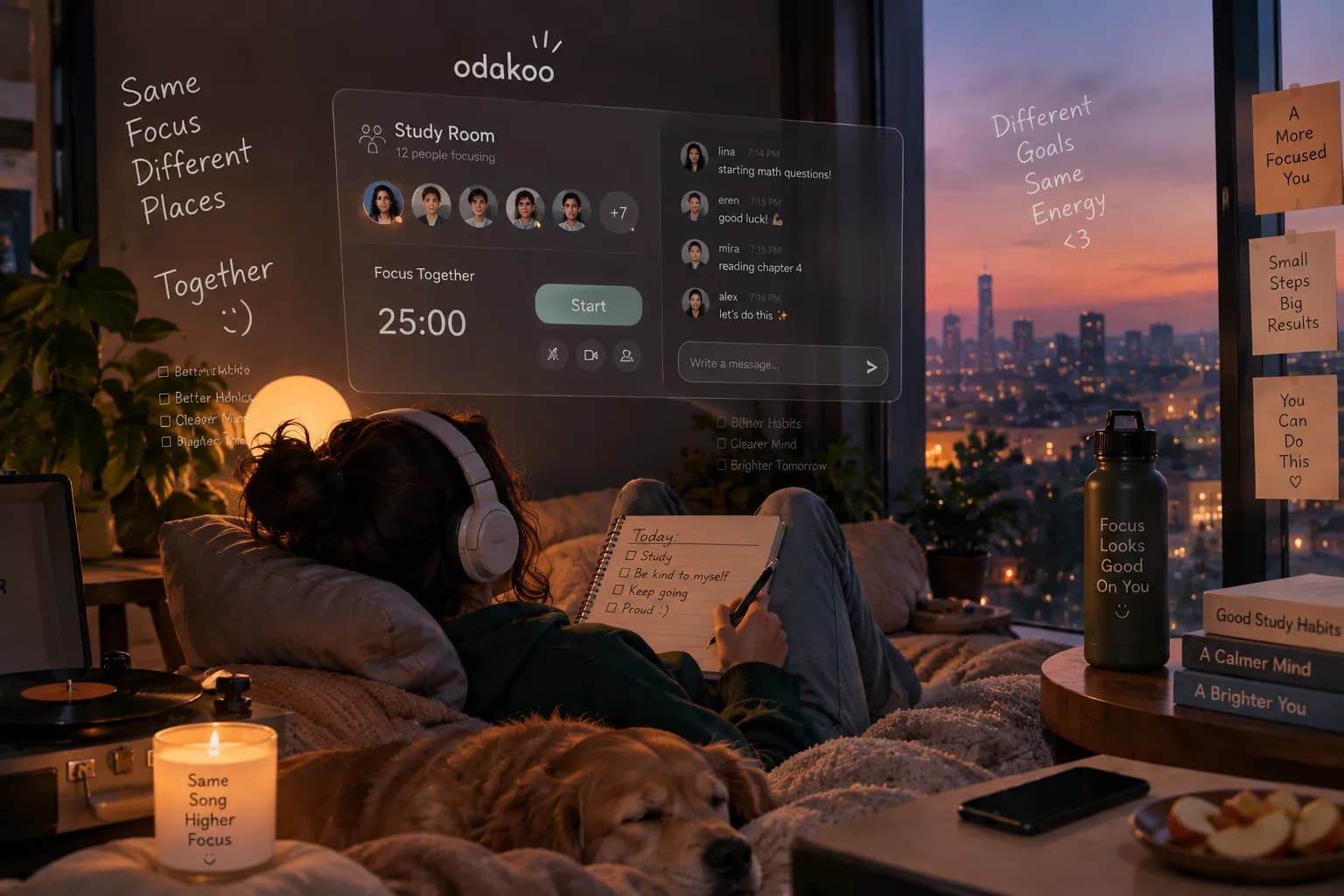
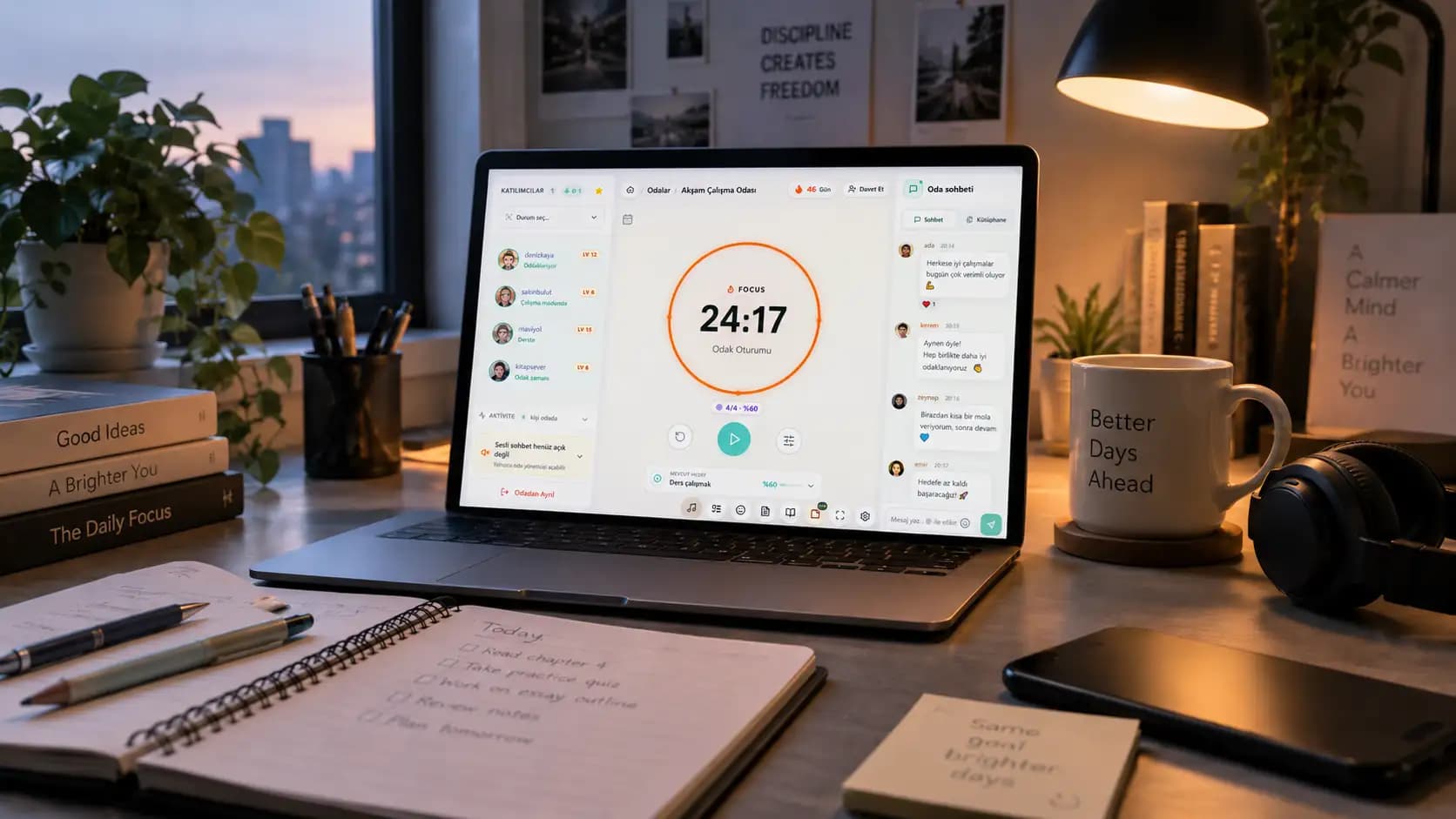
You can structure these sessions with a Pomodoro timer on Odakoo and keep the AI part limited to specific moments instead of constantly switching between your notes and a chatbot.
That matters because even a useful tool can become a distraction when it is always open.
AI Can Also Make Studying More Personal
Not every student learns in the same way.
One useful advantage of AI is that you can change how something is explained.
For example:
“Explain this like I’m a beginner.”
“Give me a real-life example.”
“Explain it visually using an analogy.”
“Explain this in simpler English.”
“Compare these two concepts in a table.”
“Explain this like it could appear on an exam.”
This is where AI becomes genuinely useful.
You are not asking it to learn for you.
You are asking it to adapt the learning material to you.
Be Careful With AI Answers
AI can sound very confident even when it is wrong.
That means you should not treat every answer as a fact.
For important information, especially academic definitions, formulas, historical dates, scientific claims, or citation-based assignments, verify the answer using your textbook, teacher, academic sources, or trusted websites.
AI is useful for understanding.
It should not automatically become your only source.
Do Not Let AI Destroy Your Focus
There is another problem that students rarely talk about.
AI can become another tab you constantly check.
You start studying biology.
Then you ask AI one question.
That question leads to another question.
Then you rewrite your notes.
Then you ask for a better version.
Then flashcards.
Then a table.
Twenty minutes later, you have created a beautiful study system — but you have barely studied.
This is productivity procrastination.
The solution is simple: give AI a specific role before starting.
For example:
“I will study for 25 minutes without AI. After the session, I will use it for five minutes to test myself.”
Tools like Odakoo can help here because you can separate your focused study periods from your breaks instead of continuously jumping between tasks.
When Should You Avoid AI?
There are still moments where it can be better to work completely on your own.
For example:
When solving practice exams
When testing your memory
When writing your first draft
When practicing mental math
When preparing for an exam where AI will not be available
When you already know you rely on AI too quickly
Your brain also needs practice working without assistance.
Think of it like using a calculator.
A calculator is incredibly useful, but if you use it for every tiny calculation, basic mental skills can become weaker.
The same principle can apply to AI.
The Best Way to Study With AI in 2026
The students who benefit most from AI probably will not be the ones who ask it for the most answers.
They will be the ones who know when to use it.
Use AI to:
Ask better questions
Generate practice
Find weak areas
Explain confusing concepts
Create quizzes
Give feedback
But keep the important part for yourself:
Remembering.
Thinking.
Struggling.
Connecting ideas.
Solving problems.
Because the goal of studying has never been to produce the perfect set of notes.
The goal is to change what your brain can do without those notes in front of you.
Final Thoughts
AI can be one of the most useful study tools students have ever had.
But only if you keep yourself in the learning process.
The next time you feel stuck, do not immediately ask:
“What is the answer?”
Ask:
“What could help me figure out the answer myself?”
That single habit can completely change the way you study with AI.
And whether you use AI, flashcards, practice tests, or traditional notes, the fundamentals still matter: focused sessions, regular breaks, active recall, and consistency.
That is exactly what we are building Odakoo around — a place where studying feels more focused, social, and sustainable instead of becoming another endless tab on your screen.