How to Get Back Into a Study Routine After Summer: A 7-Day Reset Plan
How to Get Back Into a Study Routine After Summer: A 7-Day Reset Plan
Summer is great at making routines disappear.
You sleep a little later. Your mornings become slower. Deadlines disappear for a while. Studying goes from something you do every day to something you keep telling yourself you will start “next week.”
Then September arrives.
You open your notes, sit at your desk and somehow 30 minutes of studying feels harder than it did before summer.
If that sounds familiar, you do not need an extreme 5-hour study schedule to fix it.
You need to rebuild the habit of starting.
This 7-day study reset is designed to help you get back into a study routine after summer without trying to transform your entire life overnight.
The goal for your first week is simple:
Study every day, make starting easier and slowly rebuild your ability to focus.
Why Is It So Hard to Study After Summer Break?
One of the biggest mistakes students make at the beginning of a new school year is assuming they suddenly became lazy.
Usually, the real problem is much simpler.
Your old routine disappeared.
During the school year, studying is connected to dozens of small signals.
You come home from class.
You see your backpack.
You have homework due tomorrow.
Your exam is getting closer.
Your friend starts studying.
These things quietly push you toward your desk.
During summer, many of those signals disappear.
So when school starts again, you are not only returning to your subjects.
You are rebuilding the system around studying.
That is why your first goal should not be:
“I need to study four hours every day.”
A much better first goal is:
“I need to become someone who starts studying every day again.”
Duration can come later.
The Biggest Back-to-School Study Mistake
Imagine you have barely studied for six weeks.
On Monday, you create a new schedule:
7:00 PM — Mathematics
8:00 PM — Biology
9:00 PM — History
10:00 PM — Reading
It looks productive.
It might even feel exciting.
Then Tuesday comes.
You are tired.
You skip mathematics.
The whole schedule falls apart and suddenly you feel like you have already failed.
This is why an aggressive back-to-school study routine often does not survive its first week.
Your first few days should feel almost too easy.
You are building momentum, not proving how disciplined you are.
The 7-Day Study Reset Plan
Here is a simple plan you can start today.
You do not need new stationery.
You do not need a complicated productivity app.
You do not need to wait until Monday.
You only need one week.
Day 1: Study for Just 25 Minutes
Your first session has one job:
Start.
Choose one small task.
Not:
“Study chemistry.”
Choose:
“Review yesterday's chemistry notes.”
Or:
“Complete questions 1–10.”
Or:
“Read pages 14–20.”
Then set a timer for 25 minutes.
You can use Odakoo's free online Pomodoro timer and start a 25-minute focus session without creating an account.
During those 25 minutes, keep the rules simple:
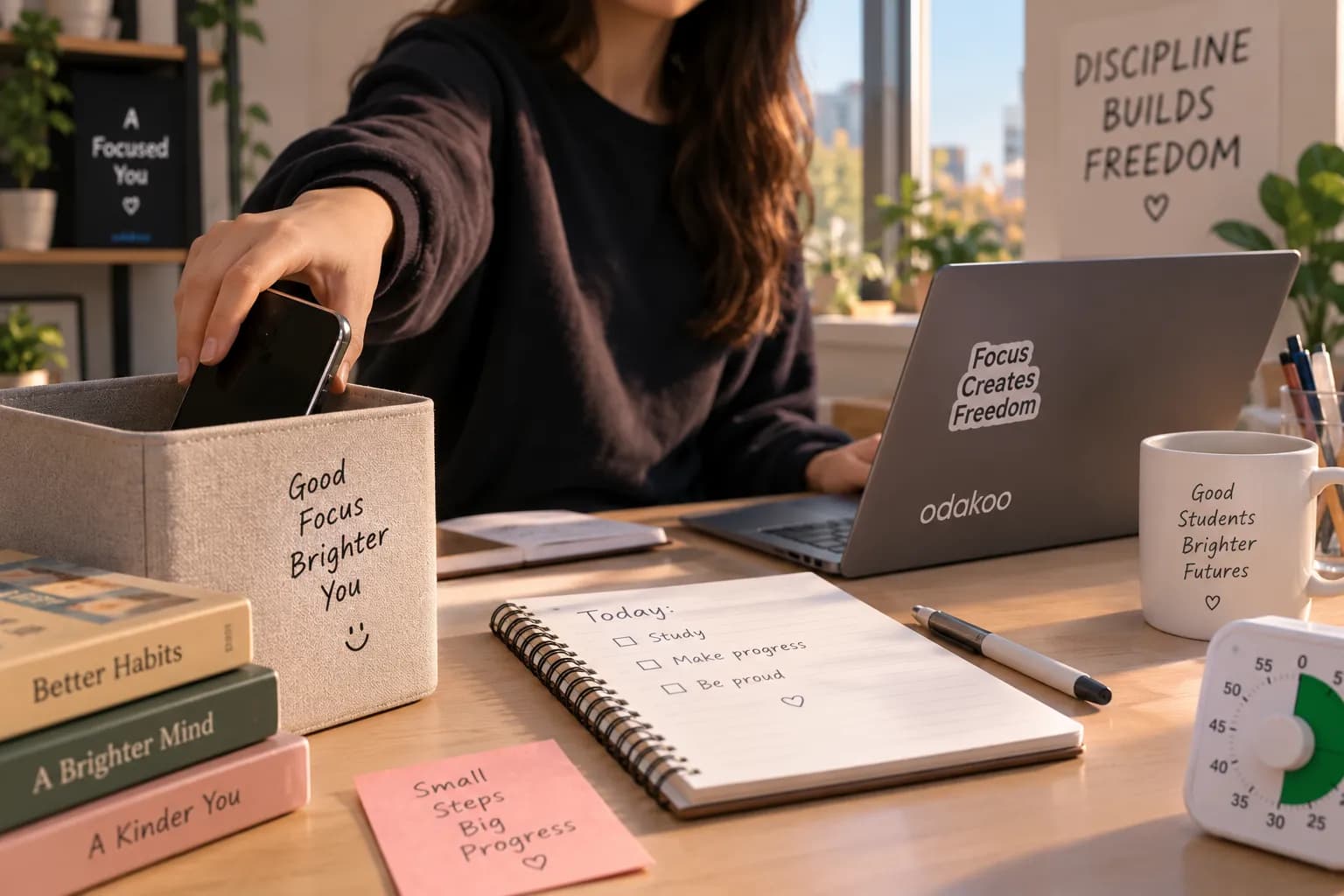
Put your phone away.
Close unnecessary tabs.
Do one task.
When the timer ends, stop.
Even if you feel like you could continue.
Day one is not about maximum productivity.
It is about teaching your brain that studying has started again.
Day 2: Fix Your Study Environment
Look at your desk before you start studying.
How many things around you can steal your attention?
Your phone?
A second monitor playing YouTube?
Discord notifications?
Five browser tabs?
A game running in the background?
A study environment does not need to look like a Pinterest desk setup.
It only needs to make the correct action easier.
Before your second study session:
Put your phone out of reach.
Close tabs unrelated to your task.
Keep water nearby.
Open the material you need.
Decide what you will study before starting.
Then complete another focused session.
Try 25 minutes again.
If that already feels comfortable, complete two sessions with a short break between them.
Day 3: Create a Study Trigger
Motivation is unreliable.
A trigger is much more useful.
Choose something that already happens every day and place studying immediately after it.
For example:
After dinner → study for 25 minutes.
After getting home from school → take a short break → study.
After making morning coffee → review flashcards.
After my 6 PM class → start one focus session.
Now studying has a starting point.
You no longer need to spend an hour deciding when you are going to work.
The time arrives.
You start.
Try to keep the trigger similar throughout the week.
Day 4: Stop Measuring Productivity in Hours
“How many hours did you study today?”
It is one of the most common questions students ask each other.
It is also surprisingly unhelpful.
Two students can both spend three hours at a desk and accomplish completely different amounts of work.
One might complete three focused study blocks.
The other might spend half the time checking messages, reorganizing notes and watching “study motivation” videos.
Start measuring something more concrete.
For example:
3 focus sessions completed
25 math questions solved
2 chapters reviewed
40 flashcards recalled
1 practice test analyzed
Hours still matter.
But completed work tells you much more.
If you use Pomodoro sessions, your day can become as simple as:
Today's target: 4 focus sessions.
That feels much easier to start than:
“I need to study for hours tonight.”
Day 5: Use Active Study, Not Comfortable Study
By day five, you should have some momentum.
Now improve what happens inside your study sessions.
Many students return to school by rereading everything.
Notes.
Textbooks.
Highlighted paragraphs.
Old slides.
Rereading feels comfortable because the information looks familiar.
But familiarity is not always the same as being able to remember something during an exam.
Turn some of your study time into active practice.
Instead of reading the same page again, close the book and ask:
What were the three most important ideas?
Instead of looking at a formula, try writing it from memory.
Instead of reading solved mathematics questions, solve one yourself.
Instead of highlighting another paragraph, create a question from it.
Make your brain retrieve information.
Studying should sometimes feel slightly difficult.
That difficulty is often the point.
Day 6: Build Your Realistic Weekly Study Schedule
Now you have almost completed a week.
This is a much better time to create a schedule than day one.
Why?
Because you now have actual information.
You know whether 25-minute sessions feel short.
You know what time of day you naturally start.
You know which distractions keep appearing.
You know whether your original expectations were realistic.
Create a simple weekly study schedule around your real life.
Not your imaginary perfect life.
For example:
Monday
2 × 25-minute sessions
Math + Biology
Tuesday
3 × 25-minute sessions
English + History + Review
Wednesday
2 × 50-minute sessions
Assignment + Mathematics
Thursday
Light day
1 × 25-minute review session
Friday
2 × 25-minute sessions
Weak topics
Saturday
Longer study block
Practice questions + weekly review
Sunday
Planning + light revision
Notice something?
Every day does not need to look identical.
A sustainable study routine can have heavy days and light days.
The important part is making it easy to return.
Day 7: Review the System, Not Yourself
At the end of the week, do not ask:
“Was I disciplined enough?”
Ask better questions.
When was studying easiest to start?
Which time of day worked best?
What distracted me most often?
Which sessions felt too long?
Which subjects need more time next week?
What made me skip a session?
Then change your system.
If you constantly skipped 8 PM sessions because you were exhausted, move them earlier.
If your phone distracted you every night, leave it in another room.
If 50-minute sessions felt impossible, return to 25 minutes.
If 25 minutes felt too short, try 50/10.
Your schedule should adapt to you.
Not the other way around.
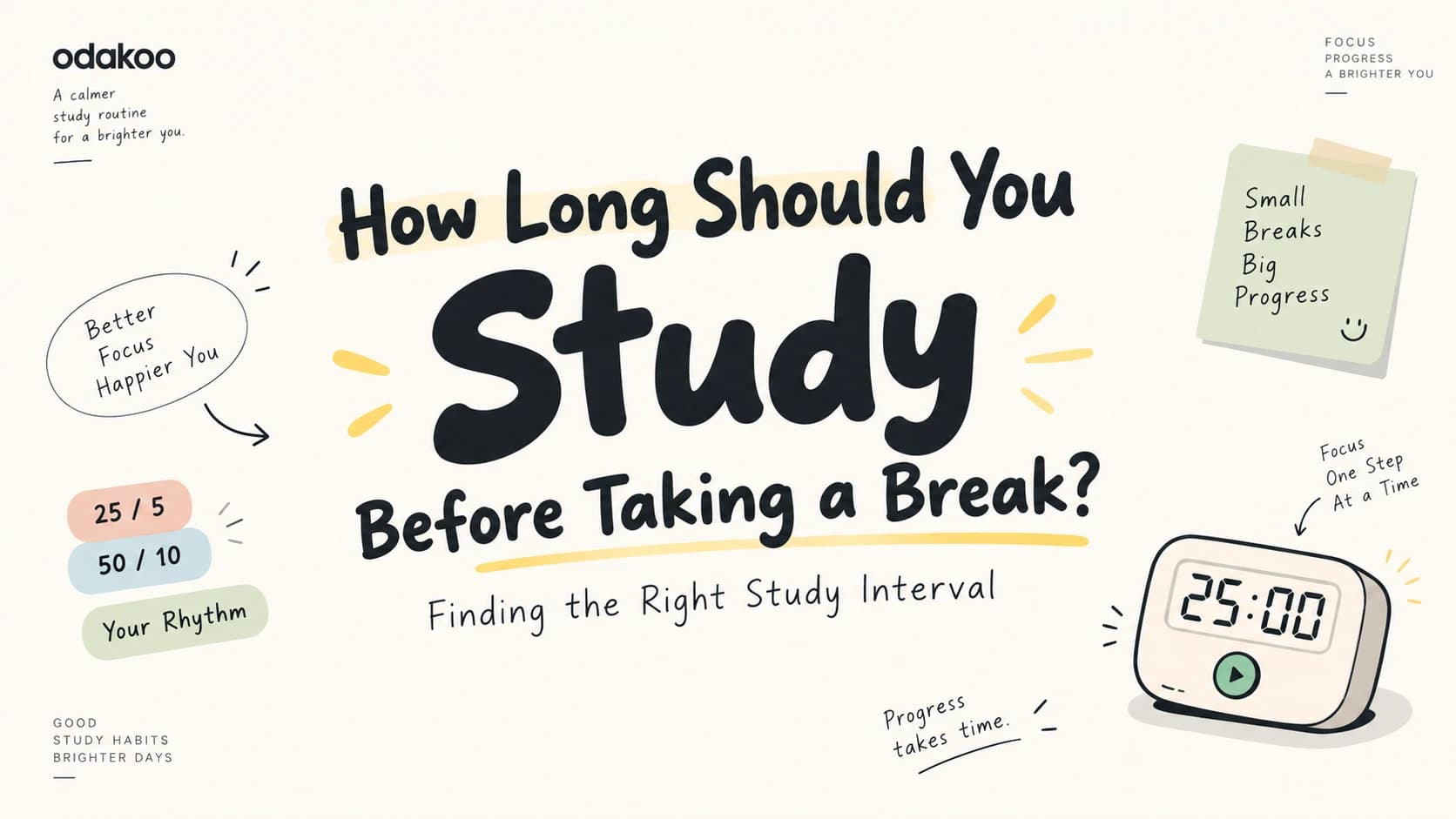
25/5 or 50/10: Which Study Routine Should You Use?
There is no perfect focus interval for every student.
The classic Pomodoro structure uses a focused work period followed by a short break.
For students getting back into studying after summer, shorter sessions can make starting easier.
Try 25/5 if:
You procrastinate before starting.
Your concentration feels weak after summer.
You are studying a subject you dislike.
You want to rebuild consistency.
You get distracted easily.
Try 50/10 if:
You can already focus comfortably.
You are writing an essay.
You are solving a long problem set.
You are reading something that requires deeper concentration.
25 minutes constantly interrupts your flow.
The best timer is the one that helps you start and return after your break.
How Many Hours Should You Study at the Beginning of the School Year?
Probably fewer than you think.
There is no universal number that every student needs.
Your workload, subjects, goals and existing knowledge all matter.
At the beginning of a new semester, consistency is usually more useful than immediately forcing yourself into an exhausting schedule.
Start with one or two focused sessions.
Then increase the workload when the routine begins to feel normal.
For example:
Week 1: 25–50 minutes per day
Week 2: 50–100 minutes per day
Week 3: Adjust based on assignments and exams
This is only an example.
If your exams are close, you may need more.
If school has only just started, you may need less.
Do not increase your study time because a productivity creator online says they study eight hours per day.
Build around your own workload.
What If You Miss a Day?
Continue the next day.
That is the entire strategy.
Do not create a punishment schedule.
Do not try to “make up” every lost minute.
Do not turn one missed Wednesday into a lost week.
Real routines are messy.
Some days you will be tired.
Some days school will take longer than expected.
Some days you will simply not feel like studying.
The important skill is not maintaining a perfect streak forever.
It is learning how to return quickly.
How to Study When You Have Zero Motivation
Lower the starting requirement.
Tell yourself:
“I only need to do 10 minutes.”
Open the material.
Start the timer.
Do the easiest useful task available.
Motivation often appears after starting rather than before it.
If you are waiting to feel perfectly motivated, you can spend an entire evening negotiating with yourself.
Make the first action small enough that negotiation becomes unnecessary.
Open the page.
Start the timer.
Do one question.
Continue from there.
A Simple Back-to-School Study Routine
If you want the entire article reduced to one routine, use this:
1. Choose one specific task.
Not “study physics.”
Choose “solve 15 questions from chapter three.”
2. Remove your biggest distraction.
Usually your phone.
3. Start one focus timer.
Begin with 25 minutes.
4. Take a real break.
Stand up, drink water and move away from the task.
5. Start another session if needed.
Do not automatically turn your break into 40 minutes of scrolling.
6. Record what you completed.
Keep progress visible.
7. Prepare tomorrow's first task before stopping.
This last step is underrated.
When you sit down tomorrow, you already know where to begin.
Your First Week Does Not Need to Be Impressive
A good study routine is not the routine that looks impressive in a screenshot.
It is the one you can still follow when the excitement of a new school year disappears.
Do not try to become a completely different student this week.
Start smaller.
Study for 25 minutes.
Come back tomorrow.
Remove one distraction.
Make your task more specific.
Add another session when you are ready.
Seven ordinary days of consistent studying can do much more for your semester than one perfect Sunday spent designing a schedule you never use.
Your study routine does not need a dramatic comeback.
It just needs a first session.
Start there.
Frequently Asked Questions
How do I get back into a study routine after summer?
Start with a short daily study session at a consistent time. Choose a specific task, remove distractions and gradually increase your study time instead of starting with an extreme schedule.
How long should I study after a long break?
There is no fixed amount, but 25 minutes can be a practical starting point if your concentration feels weak. Increase the duration as studying begins to feel normal again.
Is Pomodoro good for getting back into studying?
Pomodoro can be useful because it turns an undefined study session into a short, clear focus block followed by a planned break. A 25/5 schedule is a simple place to start.
How can I stop procrastinating at the beginning of the school year?
Make the first task extremely specific and easy to begin. Instead of planning to “study tonight,” decide exactly what you will do, when you will start and how long the first session will last.
How long does it take to rebuild a study routine?
There is no exact number of days that applies to everyone. Focus first on repeating the routine consistently rather than waiting for studying to feel automatic.