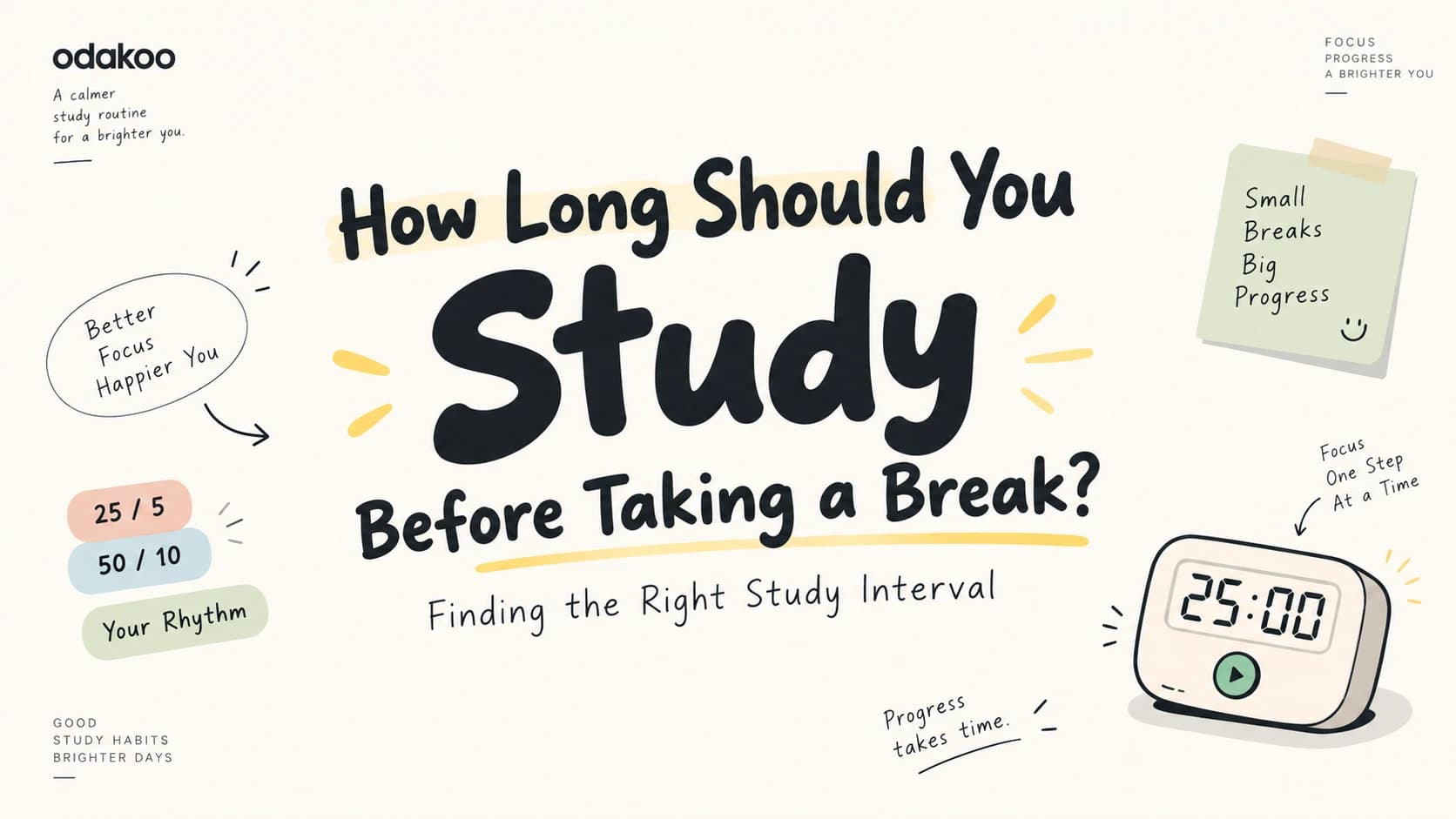
How Long Should You Study Before Taking a Break? Finding the Right Study Interval
How long should you study before taking a break? Learn how 25, 50 and longer study intervals work, when to pause, and how to find your best rhythm.
How Long Should You Study Before Taking a Break? Finding the Right Study Interval
There is a familiar point in almost every study session when reading becomes slower, the same sentence needs to be read twice, and a quick glance at the phone starts to feel unusually tempting.
Sometimes that happens after 20 minutes. Sometimes it takes an hour.
This is why advice about the “perfect” study interval can be frustrating. One person recommends 25 minutes of work followed by a five-minute break. Someone else says serious concentration only begins after the first half hour. Both can be right, depending on the person and the work being done.
There is no single study interval that works best for everyone.
The more useful question is not simply how long you should study. It is how long you can work effectively before the quality of your attention begins to fall.
Why taking breaks matters
Long study sessions can feel productive because they create a large block of time on the calendar. The problem is that time spent at a desk and time spent learning are not always the same thing.
Concentration changes during a study session. Mental fatigue builds, attention wanders and mistakes can become easier to miss. A short break can interrupt that decline before another hour is spent staring at the material without taking much in.
Research on university students supports the idea that breaks can help sustain attention, although the exact timing still matters. A 2025 study involving 253 undergraduate students found that shorter, more frequent breaks helped maintain performance more consistently during longer classroom sessions.
That does not mean everyone needs to stop every 20 or 25 minutes. It means studying indefinitely without checking whether concentration is still there is usually not a very good strategy.
Is 25 minutes the ideal study time?
Twenty-five minutes became popular largely because of the Pomodoro Technique.
The classic format is simple: study for 25 minutes, take a five-minute break and repeat. After several rounds, take a longer break.
It works well for many students because 25 minutes feels manageable. A difficult chapter becomes less intimidating when the goal is not “study chemistry all evening” but “work on this for the next 25 minutes.”
That difference matters when starting is the main problem.
But 25 minutes is not a biological limit on human attention.
If you are halfway through solving a difficult problem and completely focused when the timer rings, forcing yourself to stop may be more disruptive than helpful. The same can happen while writing an essay, programming, reading a complex chapter or working through a long practice set.
Recent research comparing structured Pomodoro-style breaks with self-regulated breaks has not found a clear learning advantage for one fixed schedule. In one study of university students, participants who chose their own break timing reported better concentration, energy and motivation in some measures, while learning performance did not significantly differ between the two approaches.
So 25/5 is useful, but it is better treated as a starting point than a rule.
When 25/5 works well
Short study intervals are particularly useful when concentration is already difficult.
If you have been procrastinating for half an hour, a 25-minute timer gives the session a clear beginning and end. The same is true when studying a subject you dislike or returning to a routine after several weeks away.
It can also work well for tasks that naturally fit into smaller pieces: reviewing flashcards, answering a set of practice questions, memorising vocabulary or revising short sections of notes.
There is little reason to make the system more complicated than it needs to be.
Pick one task, start the timer and work until the session ends.
If 25 minutes consistently feels comfortable, that is usually a sign that the interval can be extended.
What about 50 minutes of studying and a 10-minute break?
For students who already have a reasonably stable attention span, 50/10 often feels less interruptive.
Fifty minutes gives enough time to settle into a task before stopping. This can be particularly useful for problem-solving, writing, longer reading assignments and subjects where repeatedly leaving and returning to the material has a cost.
A 10-minute break also gives enough time to actually leave the desk for a moment instead of simply checking a few notifications before the next session begins.
There is nothing special about the number 50 either.
Some people settle naturally around 40 minutes. Others prefer 60.
The point is to find an interval long enough to make real progress but short enough that the final part of every session does not become wasted time.
Longer sessions can work too
Not every productive study session needs a timer ringing every hour.
There are situations where 60 to 90 minutes of uninterrupted work makes sense. Writing a paper, completing a mock exam or working through a difficult set of problems can require a longer period before stopping.
This is especially true once you enter a state of deep concentration.
The mistake is assuming that because 90 minutes worked well once, every study block now needs to last 90 minutes.
Task difficulty changes. Energy changes. Time of day changes.
A 75-minute mathematics session on Saturday morning may feel easier than 30 minutes of reading after a full day at school.
Study intervals should be flexible enough to account for that.
The task matters more than most people think
It is easy to choose one timer setting and use it for everything.
In practice, different types of study create different demands.
Reviewing flashcards has natural stopping points. A short session works perfectly well.
Solving a difficult calculus problem is different. Stopping every 25 minutes may break a line of reasoning that took ten minutes to build.
Reading can fall somewhere in between. If attention starts drifting after 30 minutes, a short reset may help. If the material is engaging and comprehension is still strong after 50 minutes, there is no need to stop simply because a productivity method says so.
A timer should support the task rather than dictate it.
How do you know when you actually need a break?
The clock is not the only signal.
There are usually signs before concentration disappears completely.
You may notice that you are rereading paragraphs without remembering them. Simple mistakes begin appearing in questions you normally understand. You start switching tabs or reaching for your phone without thinking. A task that was progressing normally suddenly feels unusually irritating.
Those moments are more informative than reaching an arbitrary number on a timer.
A short break at that point can be much more useful than spending another 20 minutes pretending to work.
The goal is not to stop the moment studying becomes slightly uncomfortable. Difficult work is supposed to require effort.
The useful distinction is between effort and unproductive fatigue.
How long should a study break be?
For shorter study blocks, a break of around five to ten minutes is usually enough to change position, get some water and mentally reset.
After several sessions, a longer break makes more sense.
If you have been working for two or three hours with short pauses in between, taking 20 or 30 minutes away from the desk is very different from taking another five-minute break and immediately returning.
Longer breaks are not automatically better, though. Research looking at rest intervals has shown that the relationship between break length and later attention is not as simple as “more rest equals better performance.”
A useful break is long enough to recover without making returning to the task unnecessarily difficult.
What should you do during a study break?
A five-minute break disappears very quickly when it begins with TikTok, Instagram or YouTube Shorts.
The problem is not that looking at your phone for five minutes destroys a study session. It is that highly engaging content makes it surprisingly easy for five minutes to become twenty.
A better short break usually involves doing something physically different from studying.
Stand up. Walk around for a few minutes. Refill your water. Look away from the screen. Stretch. Open a window.
The activity itself does not need to be productive.
The point of the break is that it is a break.
When the pause is over, returning to the same task should still feel straightforward.
A simple way to find your own study interval
Instead of deciding in advance that you are a “25-minute person” or a “50-minute person,” try paying attention to a few normal study sessions.
Start with 25 minutes if concentration is currently difficult.
If the timer repeatedly ends while you are still working comfortably, move to 40 minutes.
If 40 feels easy, try 50.
You may eventually find that one interval works for most everyday studying while certain tasks need something different.
For example, your normal routine might become 50 minutes of study followed by a 10-minute break, while vocabulary practice stays at 25 minutes and mock exams are completed without artificial interruptions.
That is a perfectly reasonable system.
Odakoo's online study timer allows both shorter Pomodoro sessions and longer focus intervals, so you can use 25/5, 50/10 or set a duration that fits the task instead of building the entire study session around one fixed rule.
Try our sweet pomodoro ui : https://odakoo.com/en/pomodoro
Breaks should not become another form of procrastination
There is one downside to structured breaks: they can make procrastination look organised.
A student studies for 25 minutes, takes a five-minute break, turns it into 15 minutes, makes coffee, checks a message, watches a video and eventually begins the next session half an hour later.
The timer is technically being used, but the rhythm has disappeared.
This is why the return from the break matters just as much as the break itself.
When the timer ends, begin the next session before deciding whether you feel motivated enough to continue.
Motivation tends to fluctuate much more than a routine does.
Do not judge a study session only by its length
A three-hour study session is not automatically better than a 90-minute one.
What happened during that time matters.
Did you finish the chapter you planned to study? Could you answer questions without looking at the notes? Did you correct mistakes from a practice test? Can you explain the topic afterwards?
Learning strategies such as spaced retrieval have repeatedly shown that how material is studied can matter much more than simply spending additional time looking at it.
The timer measures time.
It does not measure understanding.
That is why a useful study routine combines both: a reasonable amount of focused time and a clear task for that time.
So, how long should you study before taking a break?
For someone who wants a simple place to begin, 25 to 50 minutes is a practical range.
Start closer to 25 minutes if sitting down and staying focused is difficult. Try 40 to 50 minutes when shorter sessions begin to feel unnecessarily interrupted. Longer blocks can work well when the task benefits from uninterrupted concentration.
Then adjust.
Recent studies comparing Pomodoro, self-regulated breaks and other break systems have found something worth remembering: no single timing method consistently wins for every student or every task.
That is actually good news.
You do not need to discover the scientifically perfect timer setting before studying.
You only need an interval that helps you start, keeps the work productive and gives you a chance to recover before attention disappears.
The right study interval is the one that lets you return to the next session ready to do useful work again.
Frequently Asked Questions
Is studying for 25 minutes enough?
Yes, especially for short tasks or when you are struggling to start. Several focused 25-minute sessions can be more useful than sitting at a desk for hours while repeatedly getting distracted.
Is 50/10 better than 25/5?
Neither is universally better. A 25/5 schedule can make starting easier, while 50/10 provides more uninterrupted working time. The better option depends on your concentration and the task.
How many study sessions should I do in a row?
There is no fixed number. After several focused sessions, take a longer break if concentration is clearly declining. The quality of the later sessions matters more than reaching a specific number of rounds.
Should I take a break even if I am still focused?
Not always. If the timer ends while you are deeply engaged and the task has no convenient stopping point, finishing the section before taking a break can make more sense than interrupting yourself immediately.